


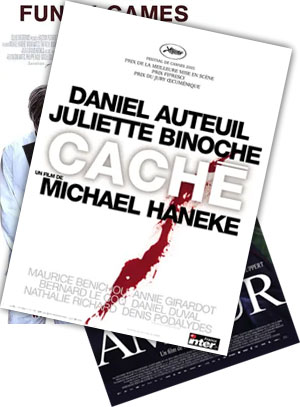
 NICHOLAS ROYLE
MICHAEL HANEKE’S FILMS RANKED
‘… when you see it again, you see a slightly different movie… it keeps changing in front of your eyes’ Francis Ford Coppola
13. The Castle (1997)
I know what Bradshaw would say. He would say that in Code Unknown, although we see Juliette Binoche walk out of the apartment building at 60 avenue de la Motte-Picquet, director Michael Haneke probably never filmed inside the building. Juliette Binoche’s apartment was not in the building, but elsewhere, in a studio, or in another building altogether. That’s what Bradshaw would say, just as he would tell you that Nicolas Roeg didn’t film any of Performance (1970) inside the house at 25 Powis Square (renumbered No. 80 in the film), which was used only for exterior shots. But I don’t care.
Because I believe. I have faith.
I also have the code for the door.
Moments after emerging from the building, Juliette Binoche, walking up avenue de la Motte-Picquet, in Code Unknown, hears someone call her name – ‘Anne,’ cries Jean, the younger brother of Anne’s partner, Georges, who has left his father’s farm to return to Paris and needs somewhere to stay. Anne goes into a viennoiserie – neither a boulangerie, nor a pâtisserie, but a viennoiserie, which it would be easy to see as a deliberate choice by the Austrian director were it not for his tendency to discourage personal readings of his films – leaving Jean wandering slowly along the pavement while Anne catches him up. She passes him a paper bag from the viennoiserie and questions him about his plans. He doesn’t want to stay on the farm with his father. She points out that her apartment is not big enough for three, but hands over her keys and tells him the code for the door – 48B13.
Jean, in the film, turns and makes his way back towards the apartment building, but, on the way, attracted by the sound of buskers, ducks into the Village Suisse arcade by the viennoiserie. A moment later, heading back out to the street, he crumples up the paper bag and drops it in the lap of Maria, a homeless Romanian woman, who, since Anne and Jean walked past in the other direction, has taken up a spot here and started begging. A bystander, Amadou, a teacher of music to deaf children, is outraged on behalf of Maria and challenges Jean, leading to an argument. The police arrive and arrest Amadou, while Jean is allowed to go on his way, presumably to use the code to gain entry to the apartment building at No. 60.
In the film, the code is uttered only once, but Anne does ask Jean if he can remember it. He says that he can. I’ve written down the code on a piece of paper, which I’ve slipped within the pages of my notebook. Perhaps I could have memorised it, but what if I forget a single character or digit? Even if I get it right, do I really expect it to work?
I believe it will. I have faith.
Arriving at No. 60, late in the afternoon, I take out my notebook, find the piece of paper on which I have written the code, which, in spite of my concerns, I did actually memorise, but it doesn’t hurt to have the note to hand. I look at the keypad, hesitate, then punch in the code.
The door does not open.
I check the code – 48B13 – and enter it a second time. Again, the door fails to open.
Glancing up at the stubby CCTV camera, I press my face up against the glass of the door and peer into the lobby. Lighting fixture on the left-hand wall, bank of pigeon-holes to the right. I take a step to my left to see if improving the angle will allow me to read any of the names on the pigeon-holes. I become aware of movement, someone approaching from behind, and move further to my left to allow the individual to get past. A tall man stands between me and the keypad and I can hear the man inputting the code. I have always wondered if it is possible to identify a code from the particular sound made as each letter or number is pressed. The door opens and the man enters and pulls the doorshut behind him before I can react. I watch as he unlocks one of the pigeon-holes and collects his post. If he had held the door open for me, I am not even sure I would have followed him in. What if he had challenged me?
Have you just moved in?/Are you visiting someone?/What are you doing here?
I move away slightly from the door to a position where, in the event that a resident leaves the building, I will be able to immediately start walking, as if already in the process of walking towards the building, and to reach the door in order to catch it after the departing resident, who might even hold it open for me. It’s a difficult balance, I realise, between appearing to be waiting there and appearing to be already in motion towards the door. This is where smoking would be useful. As a resident myself, I have just stepped outside for a cigarette and now, as you leave the building, I throw my dog-end away, extinguish it with my shoe, and move towards the door to re-enter. But I don’t smoke, and still nobody is coming through the lobby to leave the building.
Now, though, a woman is walking diagonally across the pavement towards the door. I turn to watch her as she walks past me, but I don’t follow her. She inputs the code, the keypad hidden from my view by her shoulder, and pulls open the door and passes through. She leaves the door to close by itself and I could catch it and enter after her, but she is stopping by the pigeon-holes. I can’t do it. I mean, I could, but I can’t. I feel paralysed. She would feel threatened. Perhaps she would cry out, shout for help, raise the alarm. I have not thought this through. I decide to wait for the next person.
The next person is not slow to arrive, but again they come from the street. It makes sense, I realise, as I think about the time of day. People are coming home from work. Unless I come in the morning, when people might be going out, to work, this is how it’s going to be, people coming into the building rather than going out of it, and my experience is going to remain similar to that of K, trying to gain entrance to the castle, in Kafka’s novel, and, indeed, Haneke’s 1997 film is based on it. In his article in the Guardian, ‘Michael Haneke films – ranked!’, published in March 2023, Bradshaw didn’t even include The Castle. Why not? Because it was made for TV? Or because he thought it was no good? Is it conceivable he didn’t know about it? I didn’t know about it until I came across a copy on DVD, second-hand, but Bradshaw is the chief film critic of the Guardian. Of course he knew about it. And of course I bought it, expecting a marriage made in heaven – Haneke and Kafka, like Resnais and Robbe-Grillet – but soon realised it’s closer to Nicolas Roeg and Dennis Potter’s Track 29 (1988). Yes, as disappointing as that was (considering how good it should have been). Endless uninteresting shots of characters exchanging lines of dialogue, with occasional grappling. I kept the DVD, but doubted I would watch it again.
12. Time of the Wolf (2003)
If someone wanted to enter a building in Time of the Wolf, they’d just enter it. They wouldn’t care about tailgating. They’d just tailgate – and then shoot the person they’re tailgating. They’d expect to be challenged and wouldn’t care. They’d shoot the person challenging them. Or you’d shoot them. Because there are no rules in post-apocalyptic films. Or the rules are rewritten from scratch. Society has broken down. Let’s rebuild it – but brutally, cruelly. It’s too easy, as drama. Nothing works, anything goes. The Road (2009). Bird Box (2018). Even The Bed Sitting Room (1969). Fine if you like that sort of thing. Time of the Wolf – well-made, well-acted, and as Bradshaw says, ‘There is a sense of apocalypse in every Haneke film, of course: the film’s certainty that this is what is coming for all of us is very unnerving.’ Still, he ranks it ninth out of twelve. None of its undeniable qualities makes me want to see it again.
11. 71 Fragments of a Chronology of Chance (1994)
I return to 60 avenue de la Motte-Picquet the following morning. The moment I arrive, the door opens. A woman emerges and walks off down the street. The woman is not Juliette Binoche and she doesn’t exactly hold the door open for me, but I catch it before it closes and slip inside. I move forward into the hallway, checking for a concierge or security guard and seeing neither. I hesitate by the pigeon-holes on the wall on the right and search among the names for ‘Binoche’ or ‘Laurent’. Juliette Binoche’s character’s name in Code Unknown is Anne Laurent. You’re wasting your time, Bradshaw would say. But is it not interesting, I would reply, that Juliette Binoche’s character’s name in Haneke’s 2005 film Hidden was also Anne Laurent? In Code Unknown, released five years before Hidden, Anne Laurent is an actress, while in Hidden, Anne Laurent works as a publisher. The two characters look alike – naturally, since both are played by Juliette Binoche – but have different jobs and are married to or are in long-term relationships with different men. In Code Unknown, Anne Laurent lives with war photographer Georges, no surname given, played by Thierry Neuvic; in Hidden, Anne Laurent is married to television presenter Georges Laurent (Daniel Auteuil).
By now, I’ve climbed the stairs to the second floor. Views out of the windows of Juliette Binoche’s apartment in Code Unknown suggest that if the apartment is indeed in the building, it is higher up. The building has nine floors. I continue to climb.
You do know, says Bradshaw, falling in step beside me as we climb up through the building, that it’s not just in Code Unknown and Hidden that the two main characters are called Anne and Georges Laurent, don’t you? It’s the case in several of Haneke’s films. You do know that?
Yes, I do know that, I say, but what I don’t know is why you leave it out of your reviews of Code Unknown and Hidden and your article ‘Michael Haneke films – ranked!’ – but I see I’m saying it to an empty stairwell.
71 Fragments of a Chronology of Chance is the third film in Haneke’s so-called Glaciation Trilogy, following The Seventh Continent and Benny’s Video, and the least involving and entertaining of the three, if it even makes sense to talk about Haneke’s films in terms of entertainment. Various stories are intertwined, taking place in the run-up to a fatal shooting in a Vienna bank. There’s a Romanian orphan, foster parents, a young man with a gun, another couple with a young baby, a grumpy old man. Three will be fatally wounded in the attack. Perhaps the most interesting thing about the film is how similar is its construction to that of the later Code Unknown, a film that generously repays multiple viewings.
10. The Seventh Continent (1989)
A driver who keeps his or her car in a garage has a preference either for driving in nose-first or for backing in. As any driver knows, what’s more important is how they get to drive out of the garage, forwards or in reverse, which is of course determined by how they drive in, since in a normal-sized domestic garage you cannot turn a car around.
In The Seventh Continent, Haneke’s first theatrical feature, originally intended for television (according to Bradshaw), the father drives the car forwards out of the garage and, later, when he returns home, backs in, so that, when he next drives out, he’ll be able, once more, to drive out nose-first.
Attention to detail.
This is early on in the film. Later, once things have started to go awry, and they go awry pretty badly in The Seventh Continent, he drives in nose-first. If he drives out again, we don’t see it, but if we were to, he’d be backing out, because that’s not something Haneke would get wrong.
In Michael (2011), by fellow Austrian director Markus Schleinzer, a man called Michael keeps a car in the garage of his suburban home. In the soundproofed cellar, meanwhile, he keeps a ten-year-old boy called Wolfgang. Michael lets Wolfgang come out of the cellar from time to time – to help with the washing-up after an evening meal, to watch a little television – before locking him up in the cellar again afterwards. Michael allows himself conjugal visits to the cellar, following which he can be seen washing himself carefully in his bathroom.
Michael drives his car into the garage nose-first and later drives it out – nose-first. Is this a mistake? A continuity error? Would Haneke have made such a mistake, had he directed the film, which (again according to Bradshaw) he was at one point considering? He would not, but nor, I believe, would Schleinzer, who appears to insist on the same level of icily maintained control over every detail of Michael as does Haneke over The Seventh Continent. The apparent continuity error can only be deliberate, but what does it mean? And more to the point, why does Bradshaw, in his glowing five-star review of the film, choose not to mention it? Does he think it would constitute a spoiler? Or is it too trivial a matter? Is it more or less trivial than the question of the door furniture on the doors to the apartments in 60 avenue de la Motte-Picquet? The apartment doors in Code Unknown are fitted with angular, silvery handles, but having got inside 60 avenue de la Motte-Picquet, in real life, and climbed to the top of the building, I find, on all floors, altogether classier, round, gold knobs that fit snugly into the palm.
Apparently a mistake, although perhaps not a continuity error, unless we’re talking about continuity between the real world and the world of the film, which is not what is usually understood by continuity error, but Haneke would not make a mistake like this, just as Bradshaw would surely not fail to spot such a mistake, were one to have been made, which it couldn’t have been. Which leaves us with the question, why would Haneke change the door furniture? And if your response to that is that he didn’t, he wouldn’t, let’s not forget, as I’m sure you wouldn’t, that in Hidden he changes the name of the street where Anne and Georges Laurent live from rue Brillat-Savarin, a real street in the 13th arrondissement, to rue Vulpian, also a real street but, in the real world, located a kilometre and a half to the north.
The Seventh Continent starts with a tight focus that excludes actors’ faces. We see hands performing actions, but no sense of who is performing them, although soon we understand there’s a family group – mother, father, daughter. Before long we see the father buying hammers, saws, even a chainsaw, from a hardware store. Not a reassuring development in a Haneke film. The father writes to his parents telling them they’re going away. The mother has already told someone else they’re emigrating to Australia, a motif, in the film, of escape from the humdrum.
Then it begins, the destruction, and once you’ve seen this part of the film, there’s no need to see it again. Second time around, you find that what was shocking becomes boring, and what seemed particularly shocking becomes a distraction. If you’re one of those people who thought that the KLF setting fire to a million pounds was a bold, striking, memorable act of social criticism, an act, perhaps, admirable in its pure anarchism, then you might enjoy watching money get flushed down the toilet. But if, instead, you are someone who finds it distasteful or even immoral – and it doesn’t matter if Haneke has printed up a load of fake money, because the damage, in terms of the distraction, the breaking of the suspension of disbelief, is already done – then this will just wind you up. The fact is, there’s a sense of entitlement about Haneke, almost an arrogance, that makes you think it’s real money.
Of course, I know who’d know, if I were to get a chance to ask him.
Bradshaw, in his review of The Seventh Continent, steers clear of discussing this, preferring to highlight the film’s ‘alienation’ and ‘nihilist horror’. Maybe he dug the KLF. In his Guardian review of Chris Atkins’s documentary, Who Killed the KLF? (2021), Bradshaw does mention ‘all the poverty in the world’ and uses the word ‘misfire’ to describe the act, but ultimately cuts the KLF a bit of slack – ‘a misfire born of their absolute refusal to conform to the careerist notion of success’.
They still burned a million quid that in 1994 could have bought, for instance, a Magnetic Resonance Imaging scanner.
9. Funny Games (2007)
I never understand – and never will understand – why British actors are so often cast in American parts.You listen, with a different level of attention, to the emphasis they place on vowels or to the way they emphasise consonants, either because you want them to get it right or because you hope they’ll slip up. It’s distracting. I think Tim Roth does a good job in Haneke’s pointless US remake of his 1997 original, but not being American, I can’t really tell. It would have been pointless with an American in the role. With Tim Roth in the role, it’s pointless and distracting. Also, the shooting is not as well executed, on a technical level, as in the original. The victim is pulled backwards into the wall a split second before we hear the shot. Fine margins, but if you’re going to do that stuff, you’ve got to get it right.
Otherwise, according to Bradshaw, ‘The remake very efficiently reproduces the steely, ice-cold horror of the original. But why duplicate it?’ He’s right and he asks the right question. Of course.
8. The White Ribbon (2009)
‘There is no clear solution to the mystery,’ says Bradshaw, ‘but its sinister riddle is unforgettable.’ I have to disagree, since I’ve mostly forgotten it. Yes, it’s beautifully photographed in black and white. Yes, there are even moments, or ‘grace-notes’, as Bradshaw calls them, of humour. It’s a very fine film, but it’s a period film and it’s not set – or shot – in Paris. Two marks against it for me. Bradshaw ranks it third. I can’t put it higher than eighth.
7. Benny’s Video (1992)
I first met Bradshaw when he came to Paris to do an event in a bookshop. He’d published a book of short stories and was promoting it like any publisher’s dream author. It was awe-inspiring to watch, on social media. He didn’t let up. But he always got the balance just right, the balance between self-deprecation and false modesty, between not posting enough and being in your face, because he had a rare, winning combination: a sophisticated sense of humour and the common touch.
He was disarmingly honest about how he landed one of the most coveted jobs in arts journalism. He was at the Standard and he wasn’t even the film critic and the Guardian got in touch. Derek Malcolm was winding up his quarter-century as the Guardian’s film critic and they asked Bradshaw if he wanted the job and he said yes.
What else was he going to say?
He was smart enough to understand that the moment his first byline appeared, hundreds of hungry young men up and down the length of the United Kingdom – or, in truth, angry young men up and down the length of the Northern line – who had been waiting for the call would immediately start sticking pins in Peter Bradshaw action figures. Not only had he got the job they all wanted, but he’d got it with no previous track record of film criticism. There was no evidence he’d ever seen a film, never mind knew his Kieślowski from his Skolimowski.
Before the bookshop event in Paris, I had made sure to follow him on Instagram, where he had posted about David Robert Mitchell’s 2014 horror It Follows. ‘Yeah, It Follows,’ I wrote in a comment, ‘but do you?’ because he hadn’t followed me back before the bookshop event, and nor did he do so afterwards, even though I bought his book and asked him to sign it. In conversation with him, I mentioned Nicolas Roeg’s Don’t Look Now and he said did I know they didn’t film the famous love scene in the hotel in Venice where the lobby scenes and exteriors were filmed, but in another hotel, also in Venice? At least he had the intelligence and good taste not to inform me that Donald Sutherland and Julie Christie hadn’t actually been having sex.
Benny’s Video is Haneke’s second theatrical feature, but his first film in which he reveals the importance, in his work, of video – as a medium, as an aesthetic, as a means of control. Benny watches videos, constantly. Or has them playing, constantly, while he listens to music or does his homework. He has cameras running, one filming the inside of his bedroom, another the view of the street outside his window, while the blinds stay down. When his parents are away for the weekend, he invites a girl back. Using a stun gun, he kills her, then kills time waiting for his parents to come home. Meanwhile, we’re worrying about the disposal of the body. When will he do it? How will he do it? Will he even do it? He doesn’t appear to be giving the matter any consideration.
Haneke keeps the story moving one step ahead of wherever you think it might go next.
On my way back down through the apartment building at 60 avenue de la Motte-Picquet, I come upon a door limned with light. If you’ve ever been in a building where they shot a film, if you have hovered outside a door beyond which arc lights once burned, you will have seen this phenomenon. You will know what I’m talking about.
I don’t see what apartment it is. I don’t even see what floor it is. The light is all I can see. The door to the adjoining apartment opens and a man emerges and looks at me. He asks if he can help me, but I can tell he’s not really interested in helping me. I hurry away.
6. Funny Games (1997)
Unbearable. Tension like violins.(Mozart’s Clarinet Quintet in A major.) No way out. Nothing will get better. The thing you hoped wouldn’t happen has happened. And yet. The sly winks to the viewer, frantic search for the remote, astonishing rewind – these add another, troubling dimension. The first time I saw this, I had intended to watch Haneke’s own 2007 US remake straight after, for comparison, but couldn’t stomach it. The second time I watched it, when you know what’s coming, was when I found it unbearable.It’s a great film, but I don’t ever want to see it again.
When I was young, I was a terrible writer. When I say young, I mean late teens, early twenties. I wrote film reviews, longhand, in blue exercise books. I called them Now Showing. Now Showing 78, Now Showing 79 and so on through to Now Showing 83. I don’t know what happened in 1984. I think of them, collectively, as my Cahiers du cinéma, a joke that only people who understand French and have some knowledge of cinema history are likely to get. An elitist joke? Maybe. Pardonnez-moi.
I reread them now and I cringe. Don’t worry. I’m not going to quote from them. I’m not even sure why I mentioned them. Unless as evidence that I’ve loved film for a long time. That I’m serious about it. It’s not a passing phase.
Maybe that counts for something. Maybe it could be a mitigating factor.
5. The Piano Teacher (2001)
There are some genuinely shocking moments in this fascinating study of a repressed, abused piano teacher with transgressive sexual desires, but arguably what’s most interesting is to see some types of shots that would later be further developed in Hidden.
Well, one type of shot. A long shot held on a building that people are leaving or have left.
People leave buildings. Characters leave locations. Cast and crew leave film sets.
The light stays behind.
You’re walking down the street. Maybe it’s a street you’ve never walked down before, or maybe it’s a street you know well, but there’s something different. You sense it in a heartbeat. The light. There’s a brightness to film lights that’s like you’re dangerously close to the sun. You see it before you see it. You see it before you know what it is. Molten silver? Mercury? It’s too bright simply to fade away when the current is switched off at the end of the shoot. It’s sticky. It sticks around. It clings, invisibly, to fabrics and walls, items of furniture. Waiting. Waiting to be reignited. A shaft of sunlight refracted off the bevelled edge of a mirror, and the room, the former set, is awash, bathed in it.
You’re walking down the street. Again. You see the light behind a window, a blind, a curtain. A screen bleeding light. You look for craning lights like sunflowers, a congestion of white trucks and vans, grips and best boys in constant motion, solitary, stationary security men, walkie-talkies in hand – but they’re long gone, the film shot, wrapped, cut and already password-protected, trickling across some forgotten recess of the internet. The film exists, and yet in the rooms and spaces where it was shot, it continues to be shot. Nothing is finished.
4. Happy End (2011)
The lukewarm reaction this film received – Bradshaw ranks it tenth – makes no sense. It may not possess quite the same tension as Haneke’s best films, but there’s plenty here to satisfy his admirers. Isabelle Huppert is back and as sharp as she was a decade earlier. The restaurant scene is almost as uncomfortable as a similar scene in Joanna Hogg’s Archipelago (2010), which Haneke could have seen before shooting Happy End. The timings work. Superficial similarities between Hogg and Haneke were not lost on Bradshaw, but, characteristically, in his review of Hogg’s 2008 feature film debut, Unrelated, he turns his observation into a joke. Imagining how other directors – Lucrecia Martel, Alexander Payne, Lukas Moodysson – might have filmed her material, he then turns to the Austrian: ‘… if it was made by Michael Haneke, of course, everyone would be tortured to death by strangers over 180 minutes of screen time.’
By 2014 and the release of Hogg’s Exhibition, about D (Liam Gillick) and H (Viv Albertine), artists who live together in a modernist house in Kensington, Bradshaw writes, ‘D and H are a world away from, say, Alan Bennett’s Stringalongs, and they are also subtly different from Daniel Auteuil and Juliette Binoche as the troubled couple in Michael Haneke’s 2005 drama Hidden, who like D and H live high-status lives almost barricaded inside a gorgeous modern home in the middle of a capital city.’
When I next see Bradshaw, I’ll ask him if he knows that the house in Exhibition, designed by James Melvin, has been demolished.
3. Amour (2012)
Happy End is good, very good even, but it’s kept out of my Haneke top three by the film that Bradshaw put at number one. Amour, then, is a profoundly moving film about an elderly couple in their last days together. Anne (Emmanuelle Riva) comes back from hospital in a wheelchair after an unsuccessful operation. Following a stroke, she is now paralysed down her right side. Georges (Jean-Louis Trintignant) puts her to bed and she asks him if he bought the new book on Harnoncourt (an Austrian conductor. No, me neither), which he says he’s read. She’d like to read it. He fetches it for her. She starts reading.
Anne’s condition worsens. She says she would rather die.
Later, Georges sees Anne playing the piano in their apartment. The next shot is of Georges listening to the piano being played. He gets up and presses a button on the CD player. The music stops. I wondered if at this point Haneke would show us the empty piano stool, to confirm that it had been a hallucination, but he doesn’t, because he didn’t need to. A less confident director would have shown us the empty piano stool, like I described the empty stairwell earlier, after I said that Bradshaw had appeared alongside me on the stairs in the building at 60 avenue de la Motte-Picquet, but it’s clear to me that I’m not as confident a writer as Haneke is a director.
The question of when I will see Bradshaw again takes hold of my imagination.
Amour is perfect, but depressing, and although it is set in Paris, it was filmed on a sound stage. Light does not stick to the fake walls of sound stages, or rather it sticks to them as it sticks to the books on the shelves and the lampshades and the blinds and whatever else was obtained by the set dressers and will be discarded or redistributed by them once the set is struck, the various elements returned to storage or scattered to the four winds as appropriate. Six months later, a young woman in a second-hand bookshop will pluck a book from a shelf and as she holds it up to her nose and riffles the pages she will wonder at a trick of the light that briefly turns up the brightness in her corner of the bookshop.
2. Code Unknown (2000)
‘Powerfully confident, cerebral, uncompromising film-making,’ writes Bradshaw. ‘Cerebral’ is right. If we accept Julien Green’s contention that Paris is shaped like a brain, the apartment building at 60 avenue de la Motte-Picquet must be located either towards the back of the frontal lobe, which handles the higher mental functions such as concentration, planning, judgement, emotional expression, creativity and inhibition, or at the front of Broca’s area, home to the muscles of speech, either being a good fit for Haneke, or for Juliette Binoche’s character, Anne Laurent, in Code Unknown.
I turn left out of the building at 60 avenue de la Motte-Picquet and walk in the footsteps of Juliette Binoche, crossing side streets that still lead, as they do in the film, to the Village Suisse. I would go into the viennoiserie that Juliette Binoche goes into and buy a chausson aux pommes and eat it as I go, and maybe I would crumple up the paper bag and look for a beggar’s lap to throw it into, and then find that I can’t do it, but the reality is that I really can’t do it, because the viennoiserie is now a shop selling antique rugs. Maybe it always was, says Bradshaw’s voice in my ear. I do find a beggar sitting on a step, not in the same spot as in the film, a little further up the street, but when I put my hand in my pocket, I don’t have any change.
1. Hidden (2005)
I have seen Hidden enough times now to know – to have discovered – a hidden truth not just about that film, but about all films.
Hidden is David Lynch’s Lost Highway (1997) revisited. A mysterious VHS cassette containing video footage of their home is delivered anonymously to Anne (Juliette Binoche) and Georges Laurent (Daniel Auteuil), just as similar tapes arrive on the doorstepof Fred (Bill Pullman) and Renee Madison (Patricia Arquette) in Lost Highway. Additionally, in Lost Highway, there’s a man’s voice on the entryphone: ‘Dick Laurent is dead.’ It was not until Code Unknown – three years after Lost Highway – that Haneke added the surname Laurent to his recurring character names of Anne and/or Georges.
Given that Bradshaw knows everything there is to know about film, I still find it hard to believe that in his Guardian review of Hidden, in which he praises the film highly, giving it five stars, and describing Haneke’s vision thus, ‘as cold and unforgiving as the surface of Pluto’, he makes no comment on the similarities with Lost Highway. I will ask him about this when I see him next, when he comes to Paris for the event I have invited him to in Romainville. I’ve sold it to him as a meeting of a book group, an opportunity for him to talk about and sell copies of his collection of short stories – I’ve offered to pay his travel and provide accommodation, which he may not need, and I believe he’ll say yes – but he couldn’t possibly object to a question about Hidden, especially in Romainville.
At the start of Hidden, we watch a long shot of a house in a street in Paris. The house, on rue Brillat-Savarin in the 13th arrondissement, has a row of high, narrow windows across the first floor of its recessed front elevation. The static camera that is filming the scene can only be located in the adjoining rue des Iris, close to the junction with rue Brillat-Savarin, and yet it’s not there, or doesn’t appear to be there – Georges doesn’t see it when he walks past –because it is ‘hidden’. There is nowhere it could actually be hidden, and yet it remains hidden.
A helpful blogger points out that the name of rue des Iris has nothing to do with eyes or optical equipment or surveillance. The street is part of the Cité Florale, a micro-quartier composed of streets named after flowers (orchids, mimosas, bindweed, etc.). But irises didn’t disappear along with analogue film cameras. Even a high-definition video camera, as used by Haneke on Hidden, before it was transferred to 35mm film, has an iris.
We see Juliette Binoche leave the house.
A short time after this, the film speeds up and we understand we are watching high-definition video and that we have been watching it over the shoulders, as it were, of Anne and Georges.
Bradshaw will point to that line in his 2023 Guardian article ‘Michael Haneke films – ranked!’ – ‘David Lynch did something similar in Lost Highway’ – and I will have to think about whether to challenge him on this, whether or not the putative book-group event actually takes place. ‘“… something similar…”’ I might say. ‘“… something similar…”’ I might even shake my head.
As is de rigueur in a certain type of French film (although an international co-production, Hidden is essentially a French film), Anne and Georges have a beautiful home insulated with books. Some critics – and Haneke himself – insist that the interiors were filmed in a studio in Vienna. I don’t know why they tell us this, why they break the spell, why they destroy the magic. Especially when careful viewers can see it’s not true.
Anne and Georges have friends over. During dinner, the door buzzer goes. Georges gets up to go and answer it. Now we see Georges at the top of the steps leading down to the front door. He has just come through the doorway from the living area and is closing the door behind him, but there’s enough of a gap to see through to the dining area and glimpse the scene left behind.
Or at least there was the first time I watched the film on DVD and slowed down that particular shot.
But when I looked again, I couldn’t quite see through the doorway.
Then when I watched it again, I saw it again. Just a glimpse.
I’m not talking about hidden frames or lost scenes. I’m talking about sometimes seeing something and sometimes not. Is it that it’s always there and what changes is whether you see it or not? Is it just that you didn’t see it on the first viewing or the third viewing? You only see it on the second or fourth viewing, because your eye has been misled or you weren’t concentrating or you simply didn’t see it for some other reason? Is it that the film is constantly developing, not chemically, but narratively, in terms of its imagery, perhaps, or in terms of the connectedness between different elements of the film? It continues to ferment and grow, like a fungus. The more times you see the film, the more likely you are to see something different.
It's not only nitrate film that’s unstable.
But in regard to the glimpsed – or not glimpsed – shot of the dinner guests sitting around the table, a shot that could be offered as evidence that filming took place in the house on rue Brillat-Savarin, rather than in a studio in Vienna, it doesn’t really matter, because there are clearer shots – a glimpse of the high, narrow windows, better shots of the hall and stairs – that provide more evidence of a through-line, a line of continuity from the street, from rue Brillat-Savarin, renamed Rue Vulpian, into the hall of Anne and Georges’s house and into the book-lined passageway on the right or up the short flight of stairs straight ahead to the door to the living/dining area and from there into the kitchen.
For a long time, I stand in rue des Iris watching the house on rue Brillat-Savarin. No one goes in or comes out. Rue Brillat-Savarin is located in Paris’s temporal lobe, or association area: short-term memory, equilibrium, emotion.
I walk up, via place d’Italie, to rue Pirandello and stand across the street from the Ecole Nationale de Chimie Physique et Biologie, or the Collège et Lycée Stéphane Mallarmé as it’s renamed in the film, although we only ever see the name on a postcard sent to the Laurents’ son Pierrot and, backwards and upside down, in reflection, on the metallic roofs of cars parked outside the school.
I stand there, as still as a fixed camera, for four minutes, as long as the equivalent shot in the film. Two boys come out of the school – in the real world, corresponding to Wernicke’s area, written and spoken language comprehension – and go down the wide steps. A man and a woman go up the steps and through one of the doors into the school. A boy enters. A man and a woman go in; she is carrying a baguette. A young man comes out. A man goes in. A girl and a boy come out. The sun comes out, briefly, not from out of the school, but from behind a cloud. Six students come out, of the school, four boys and two girls. They walk down the steps and head off in the direction of rue le Brun.
In the last shot of Hidden, we see, if we look carefully, two characters having a conversation, but we can’t hear what they are saying. Haneke told Guardian journalist Jason Solomons that he did write dialogue for the scene and the characters are speaking it, but he chose not to let us hear it. If the script was ever to be published, he said, this dialogue would not be included and the actors were asked never to reveal it.
Solomons asked Haneke if he enjoyed frustrating viewers. ‘I look at it as productive frustration,’ was Haneke’s response. ‘Films that are entertainments give simple answers but I think that’s ultimately more cynical, as it denies the viewer room to think.’
I follow the six students, at a distance, and turn right on rue le Brun and then right again on to boulevard Saint-Marcel and keep walking, the six students having melted into the crowds. When I reach boulevard de l’Hôpital, I go left and cross pont d’Austerlitz. I follow boulevard Diderot all the way to Nation, then cut up to rue d’Avron and head east, towards the Périph, which I cross at the porte de Montreuil, leaving Paris, exiting the brain. I walk up avenue Gallieni and find myself entering the banlieue. Long narrow roads, low units, shops and houses on both sides. As I head north, the odd high-rise. More low-rise apartment buildings, park on the left, school on the right. Finally, I reach avenue Lénine, the high-rises of Romainville, home of Majid (Maurice Bénichou), whose history with Georges goes back to their shared childhood – shared and interrupted by an act of betrayal. If any one character embodies the meaning of the film, it’s surely Majid.
‘Part of Haneke’s project in Hidden…’ wrote Catherine Wheatley in Sight & Sound, ‘is to restore shock-value to the image, a project in which he incontrovertibly succeeds, to judge by the collective gasp that shook the cinema audience at the film’s Cannes screening during one key scene of unexpected finality.’
I’ve been in the high-rises and haven’t yet managed to locate Majid’s apartment. But I will.
© Nicholas Royle 2025
This online version of “Michael Haneke’s Films Ranked ” appears in The Barcelona Review with kind permission of the author. It appears in Paris Fantastique by Nicholas Royle, published by Cōnfingō Publishing, U.K., 2025
This story may not be archived, reproduced or distributed further without the author's express permission.
Please see our conditions of use.
Author Bio
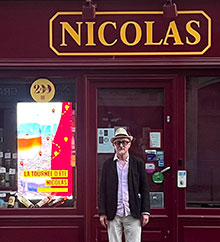 Nicholas Royle is the author of six short story collections – Mortality, Ornithology, The Dummy and Other Uncanny Stories, London Gothic, Manchester Uncanny and Paris Fantastique– and seven novels, most recently First Novel. He has edited more than two dozen anthologies and is series editor of Best British Short Stories for Salt, who also published his books-about-books, White Spines: Confessions of a Book Collector and Shadow Lines: Searching For the Book Beyond the Shelf. In 2009 he founded Nightjar Press, which continues to publish original short stories in the form of limited-edition chapbooks. Forthcoming, from Salt Publishing, is Finders, Keepers: The Secret Life of Second-hand Books.
The Barcelona Review is a registered non-profit organization