


 DAVID HUTTO
THUNDER NORTH
“We helping feed the world,” an older woman once said in the break room. Tate Reed had looked up from scrolling through photos of his nephews on his phone. What did she say?
“Damn,” another man had said. “They just a bunch of dead birds to me.”
“Everybody loves chicken,” she replied. “Who don’t eat chicken? We giving people a good, healthy product, cheap as you can get it.”
“They paying you for advertising?” somebody had asked.
“They paying me to trim chicken livers. That ain’t stop me from thinking.”
Tate Reed only cared about feeding one world, the one where his feet stood. That was why his bright orange Camaro with white stripes came rumbling into the parking lot at Sanders Poultry every morning before seven o’clock. Being at work at seven took some effort, because unless you’re going fishing, preferably bass fishing, early morning should mean your head is on a pillow.
One Tuesday in late April, Tate pulled into the parking lot at the chicken processing plant, listening to a country music CD turned up loud: “Ain’t Gonna Catch Me Till I’m Dead.” When the song was over, he took off his University of Georgia Bulldogs cap, put it on the seat, and got out. Leaving his enthusiasm in the car, he drifted toward a job that would take another day away from him without giving much back. He didn’t want to work at the chicken plant, although he took for granted it was where he needed to be. Even Tate knew he hadn’t been the smartest kid in high school, and he had no training for anything other than the kinds of jobs they teach you to do when you get hired. He wasn’t sure there was such a thing as a job he would actually like. Some people did like working at the chicken plant, or lied and said they did. Some had been showing up there twenty years, which sounded to Tate like the same as showing up dead all that time. When he squinted at the truth, because it didn’t bear looking at too hard, you gotta work somewhere, and you aren’t gonna like it.
Like his Dad used to say, “Boy, what you ever gonna be good for?” Wailing, weeping Jesus, how many times had Tate heard those words bark out of his old man’s mouth? He knew, same as his sister did, to keep clear of their Dad when he got home from the cabinet factory, his back hurting and in a bad mood. Sometimes when their Dad saw Tate leaving the house, at a time when Tate just wanted to play ball with other kids, the old man would stain the air with a snarl, “You ain’t never gonna amount to nothing.” At one time, Tate had been interested in electrical gadgets and thought about being an electrician, but he never went as far as trying to take classes at the vocational college. Anyway, money for that wasn’t falling down from heaven. In later years, he figured it was like his Dad just had some way of knowing how he would turn out.
For a year out of school, Tate had worked for a friend’s uncle who had a tree-cutting service, until he argued with the cheap bastard about overtime pay. That’s when the chicken days started, and Tate had been working five years at the plant. Inside the entrance that Tuesday morning people were lined up to sign in and start the shift, what the management called punching in, even though they did it on a touch screen. Tate yawned, standing in line behind José, who worked in the packing section beside him. Most of the workers in the chicken plant were Latino, which was common in the poultry factories of Gainesville. That early in the morning, people weren’t talking much, except for Chucho, as usual, and why did that fatmouth have to start the day telling jokes nobody wanted to hear?
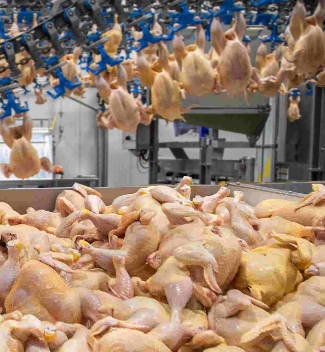
After Tate had changed into the white work outfit that included a hair covering, he headed to his section on the other side of the plant. The space loomed more than two stories high, with shining steel machinery everywhere you looked, complicated assemblies of trays, pipes, tubes, and hooks, with conveyors moving in all directions, rushing pieces of chicken toward the next saw or claw or chiller, machines so loud the workers were required to wear ear protection. A smell of raw chicken filled the plant, and while the smell wasn’t terrible, it also wasn’t leaving, except on the clothes of the workers when they went home. The temperature in the plant was kept cool, which Tate didn’t mind, but some of the workers, especially the older ones, came to work wearing extra layers to keep out the chill. He approached the packing line, where his job was to take the styrofoam trays of cut-up chicken and put them in boxes for shipping to stores.
José was already on the line moving a stack of boxes, wearing the same white outfit as Tate, including the required face mask. Tate hated the mask, and when inspectors weren’t around he would sometimes pull it down over just his mouth or even below his chin so he could, for Christ’s sake, breathe easier. He also didn’t like the ear plugs, rounded foam rubber objects like little testicles that you shoved in your ears. The plugs made his ears feel stuffed and a little sore by the end of the day, so sometimes he would pull them out and put them in his pocket, ready to pop back in if he saw an inspector slinking in their direction. As Tate approached the line, José was talking to another worker in Spanish, giving Tate the feeling he would get sometimes that he didn’t belong there. He only knew a few words of Spanish (amigo, coño, taco, and maybe one more if he thought about it), and he didn’t care what people jibber-jabbered at home, but he wished they would only speak English at work so he could tell what was being said. It was a workplace, goddamnit, and everybody should be speaking the same language.
As he began picking up the Styrofoam trays and putting them in boxes, the words to the song he had been listening to in the car ran through his head.
I’ll be running, I’ll be gunning,
I’ll be gone ’fore they know my name.
When they’re looking to control me,
I’ll be leaving this hellhole free.
Ain’t gonna catch me till I’m dead.
The song was by Robbie Calloway, Tate’s favorite country singer. Tate had been twice to see him perform, owned all of his CDs, and was wearing out the one in the car. With Robbie singing in his head, Tate got into a rhythm of work: tray of chicken, I’ll be running, tray of chicken, I’ll be gunning, tray of chicken, I’ll be gone, tray of chicken... The trays were coming along the line so fast that Tate, José, and two other workers stayed busy grabbing them off and packing the boxes to send out to a hungry world. Lately Tate’s shoulder had started to ache a little by the end of his shift from the repetitive motion, but hell, he figured that’s how it is when you work. His Dad used to come home hurting from the cabinet factory every day.
The morning went like the day before, like the next day would go, and the day after that, and the next week, and the next month. Tate didn’t look ahead to anything, and what was there to look ahead to? Maybe going fishing sometimes, or maybe a few days in Florida now and then with his girlfriend Cindy, if she could get off work. Since he was in high school he had known that something like this was how life would be. While he was packing the boxes, his mind drifted into his favorite fantasy, seeing himself on a stage with a cowboy hat, grinning at the audience, taking the microphone to sing about whiskey and bad women and how he didn’t give a damn what the world thought. Sometimes it made Tate happy thinking about that, seeing himself that way. Other than one crap-ass job after another, the only thing he could think of that he really wanted was to be a country musician. That fantasy needed to skip over the fact that he didn’t know how to play an instrument and couldn’t sing, as Cindy had mentioned more than once.
During lunch in the break room, he was looking at his phone, reading about a bass fishing contest when José asked, “Where you get them special wheels for your car?”
Tate looked up. “You wanting to spice up your ride?” His Camaro rode on some serious blue-tint chrome wheels.
“Yeah.” José nodded slowly. “I think so. I like what you got.”
“In a place down in Atlanta.” A nice chunk of Tate’s good green paycheck had gone on customizing his machine. He laid the phone down and opened a bag of potato chips, looking at José. “It ain’t cheap.”
“That’s OK,” José said. “I want to fix mine up. Make my compinches jealous. Then we see who talks big and who rides big.”
“You just want it to look good, or you want to make some noise?”
“Roar like a lion,” José said and laughed. “I like that sound you got.”
Along with the sweet paint job and accessories of Tate’s car, he had installed aftermarket headers, taking out the exhaust manifolds and catalytic converter, so the car would rumble like a yellow-eyed beast. Emissions went up, but it didn’t matter, because Hall County didn’t have emissions inspections. When he cruised down the road and let that monster roar, people knew he was coming and they knew when he raced off ahead of them.
Just before the lunch trash was crumpled up for the can, Tate looked at his phone and saw a text to call his sister, so he went out to the hall. “What’s up?” he asked when Dina answered. His sister had two children who she was raising after that piece of shit Roger had divorced her. Good riddance to the asshole husband, but now she was struggling.
“Hey,” she said, “you on break?”
“Wouldn’t be calling if I wasn’t on break.”
“Yeah.” She paused. “So I just talked to somebody at Sam’s school. They were doing vision tests on the kids, and they think he needs glasses.”
“That young?”
“I don’t know. I guess it happens. But shit, I can’t afford glasses. I’m trying to feed these kids and keep clothes on ’em. There’s no extra.”
Tate closed his eyes for a couple of seconds and nodded. “And Roger?”
She snorted with disgust. “Are you kidding? If he’s not in Hell where he belongs, he’s sure not going to pay for his own kids to have glasses.”
“So how much?” Tate asked. He was used to helping Dina with money, and if he could help her, he was going to.
“I don’t know.” He thought he could hear his sister start to cry but hold it back. “They say if the kids can’t see in school, they don’t do as well.”
“Find out how much and let me know. I guess they’ll take payments. I hope Sam don’t break ’em. I probably would have.”
After the call, Tate was thinking about how hard things were for Dina. Him being single seemed like a vacation compared to what she was dealing with. Sometimes he tried to go over to her house and be a male influence on his nephews, like when he taught them how to whistle, except only Sam could really do it. Walking back to the packing line after lunch, Tate passed a conveyor with hooks rushing by, the carcass of a chicken hanging on each hook. “Feeding the world,” he said out loud and shook his head.
When he got back to his work station, he was still thinking about helping Dina. Maybe beers on a Florida beach with Cindy would have to wait. He was picking up an empty box to start packing it when his supervisor walked up. “Tate, we need help this afternoon on the broiler packing line.” Tate’s section was responsible for packing chickens that had been cut into parts, while the broiler line was for whole chickens.
“I don’t know nothing about working over there,” Tate said.
“It’s basically the same thing,” the supervisor said. “You’ll still be packing boxes.”
“I shouldn’t be having to move around from section to section. This is my section.”
“It’s not permanent, just for the afternoon.”
Tate didn’t move, resisting. “I know this job right here. Why you asking me to move?”
“Tate, it’s basically the same damn job. If you want to move up here and have more responsibility, you’re gonna have to learn to do more than one thing.”
“I don’t need more responsibility, I just need to do the job I know how to do.”
“Look,” the supervisor said, becoming irritated. “We need help on another line, and I’m moving you over for the afternoon. You don’t have to like it, but that’s where you’re working.”
“Why me? You could ask somebody else.” Tate glanced at the other workers, who were quickly boxing up the chicken, not looking at him or the supervisor.
“And I’m writing you up a notice note,” the supervisor said, “for standing here arguing. I don’t need you giving me dumb excuses. I need you to follow me to the broiler packing line.”
Tate was angry at being moved to a job that seemed completely different. Picking up whole chickens and putting them in the box was nothing like packing the Styrofoam trays. But worse than hellfire, he was furious his boss had called him dumb, and in front of other workers. As Tate began picking up whole chickens in their plastic bags, awkwardly putting them in a box, he thought about being called dumb and wanted to smack a fist across his boss’s skinny face.
When the shift ended at 3:30, Tate was still hot with anger and in no mood to go home. Going out to the parking lot, he thought about how it would feel to say kiss my ass, walk out of there, and get another job. He cranked his car, then sat for a minute pressing and releasing the accelerator, as the engine gave a thunderous rumble, died back, thundered, died back, thundered, died back. He did this several times until he picked up the Georgia Bulldogs hat and put it on, then pulled out of the parking lot. Instead of turning toward home, he drove east toward the interstate where he could open it up, let the speed and power move through his veins.
Once he was on that concrete blade slicing south to north, he let the beast go, gave it the fleet foot to thunder north. The engine gave a growling whine as the Camaro flew like a firebolt, and Tate went up the road moving back and forth between lanes. Speeding up to slip to the right and pass an SUV, he hoped not to get caught by the State Patrol, but he would take the chance. Sun and shadow flashed by, as the thought continued to play in his head that he wanted to walk away from that boss and find another job. He glanced down at the CD player on the dashboard and remembered the last time he had gone with Cindy to see Robbie Calloway. Then, like a surprise, a thought came to him. What if he just kept driving to Nashville? He could get a job there, maybe even working with some of the musicians, moving their stuff or something.
Just over an hour later, he blew across the state line into South Carolina. I’m going to do it, he thought. He stopped once for gas, then got back on the interstate, tapping on the accelerator to hear the deep growl of the engine rise to that satisfying high-pitched whine. He could get a job in Nashville, stay in a motel for a few days before he went back to Gainesville to load up his stuff. Maybe Cindy would come visit. In the meantime he’d send Dina some money for the glasses. Maybe he could even earn more in Nashville.
After passing Greenville, he turned in the direction of Asheville, to start working his way back west toward Tennessee. For several hours he drove, feeling calmer as he controlled the machine, still moving after the sun went down in North Carolina. Eventually he couldn’t ignore hunger, so he rumbled off at an exit and pulled through a fast-food drive-in for a hamburger. It was late spring, and he sat in his car eating with the windows rolled down, watching people in the parking lot. After he finished the food, he continued to sit, thinking and looking off at the darkness and lights and cars going by. When he started up again, he saw a sign for turning right to go north, toward Nashville. He looked at it, sat a few seconds staring straight ahead, then turned left and started back the way he had come. He wouldn’t get home until late, and he knew he would be tired packing boxes the next day.
© David Hutto 2026
This story may not be archived, reproduced or distributed further without the author's express permission.
Please see our conditions of use.
Author Bio
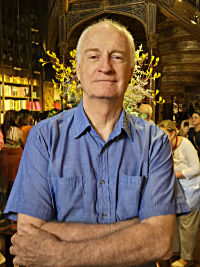 David Hutto has written novels, short stories, and poetry, shifting focus between writing about his native Georgia and tales that wander far abroad to places he has been, from Russia to Uruguay. He currently has short stories forthcoming in several magazines, including Barely South Review, and his work has recently appeared in the anthology Starved. When he is not writing or reading, he is working on art projects. His experience as a writer includes a residency at the Vermont Studio Center in 2003, as well as writers’ retreats in Mérida, Mexico in 2024 and Dublin, Ireland in 2025.
Website: www.davidhutto.com
The Barcelona Review is a registered non-profit organization