


 Garry Smout
Revisiting The Ballad of Halo Jones
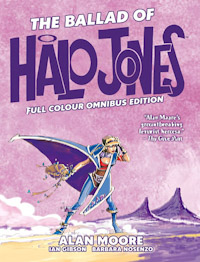
When I moved house last year, I knew I had no room for ‘Them’. Stuffed into black bin liners and stored for over 40 years and practically forgotten and definitely worthless were Them: my collection of 2000 AD comics. Among them was a story centred on a character called Halo Jones which had always had a hold over me but any desire to wade through a thousand or so disorganised comics to try and find that tale, published between 1984 and 1986 in 34 instalments, was not going to happen, so I gave them away. My simple action of riddance led to an even simpler solution: surely, there’d be a collection of the instalments in a book by now? Google said ‘yes’ so I looked at the latest offering, a full coloured (really, why?), omnibus version which had, on the front cover, a blurb from The Guardian stating: ‘Alan Moore’s groundbreaking feminist heroine’. Moore’s name rang a distant bell. He wrote this? The ‘read sample’ gave me more quotes from various sources, including some Forewords that really made out this was no longer just a throwaway comic but now an important, respected work, its author now a legend in a field I had very much been a part of but knew nothing about. And 2000 AD itself was to play a major part in the history of this genre. It was about here that I realised I had opened a Pandora’s box, a potential rabbit hole. Like Rip Van Winkle I had a lot of years to catch up on.
For a start, apart from an attempt to read Tsugumi Ohba’s Death Note (it’s from the Japanese so you start from the back page) I had never read, or been interested in, graphic novels. Certainly, younger me had read Fungus the Bogeyman, Tintin and Asterix but they were termed comic books back then. Halo Jones, like many comic stories such as Watchmen, was first serialised, but once its instalments were gathered into a single volume it became, in effect, a novel – much as happened with many works by Dickens and Conan Doyle. The trouble is author Alan Moore hates the term and as it seems he is one the most influential comic book writers in the English Language, I will use it sparingly. It did feel slightly strange holding a book version of what was once a flimsy comic, to now know the name of the author I once had so casually ignored and to witness ephemera becoming not only acceptable but also lauded.
To place the how and why of Halo Jones a bit of comic history is needed. In the late 70s the UK comic market had become revitalised thanks to the efforts of American born but UK raised John Wagner along with a native Brit, artist Pat Mills. They branched out from war comics (Warrior) and created 2000 AD, a comic squarely aimed at the 15+ to early adult male market. For their new venture they created between them the likes of Judge Dredd, Rogue Trooper, Nemesis and Sláine, a cast of characters that, in my mind, knocked the spots off the plethora of stale, cape-wearing comic heroes found in the States. Moore wrote stories for some of these characters as well as many one-off ‘Future Shocks’ stories for 2000 AD’s fictional alien editor Tharg and obviously made a huge impact as he was voted Best Writer by the Society of Strip Illustration in 1982 and 1983. This led to the US showing interest and in 1983 he was commissioned to rework The Swamp Thing for DC comics. Which he did, winning more awards and later being asked to help bring life back to Batmanand Superman. Whilst all this was going on he was already working on V for Vendetta and Watchmen, which would radically change how comic books were perceived, making him a legend. Among all this creativity he still found time to come up with The Ballad of Halo Jones.
Though 2000 AD was predominantly aimed at a male audience, artist Ian Gibson wanted to do a girl’s story that showed some respect. Moore was on the same page and though a great fan of the typical ‘guns, guys and gore’ reading fodder in 2000 AD, had no ‘inclination to unleash yet another Tough Bitch With A Disintegrator And An Extra “Y” Chromosome upon the world’. The two sat down and worked out Halo and her world – Gibson putting in the most detail in the creation of the Hoop, a floating ring-shaped housing estate moored in the Atlantic Ocean off the East coast of America, and, surprisingly, the alternative language spoken there. I hadn’t realised the importance of teamwork in comic creation and Moore touches on this in a 1983 Warrior article on the fledgling V for Vendetta:
It’s a joint effort in every sense of the word, because after trying the alternatives that is the only way comics can ever work. There is absolutely no sense in a writer trying to bludgeon his artist to death with vast and over-written captions, any more than an artist should try and bury his writer within a huge and impressive gallery of pretty pictures.
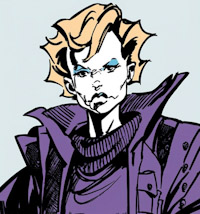 For Halo they wanted an ordinary woman, the type ‘you might find standing in front of you while queuing for the check-out at Tesco’s’ but in an environment that would work in a ‘boys’ science-fiction comic’. Quite a few pages of Book One tell of a shopping trip. A shopping trip? That seems verging on sexist, not feminist. To their defence it was for food and it turns into a violent and partly comic adventure.
Coming up with the character and story was one thing – selling it to a publisher was another, but 2000 AD were usually open to something different, and Alan Moore was a proven top-tier writer. He had given 2000 AD the recurring D.R. & Quinch, two violent, delinquent but hilarious characters who became firm favourites with myself and many other readers. (My “D.R and Quinch say Nuke Your Parents” T-shirt lasted until that move.) So, fate smiled sweetly and Halo Jones, a totally ordinary teenage girl leading a mundane life who just wanted to ‘go out’ was unleashed on the world in June 1984 to a predominantly young 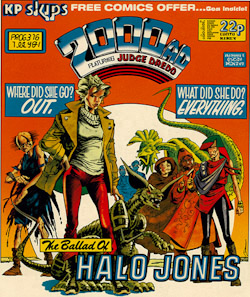 male audience as Book One. Books Two and Three would follow. Forty-two years later I pick them all up, but now as a Graphic Novel, my very first.
Erm…I didn’t remember Book One. One has to keep in mind that, apart from catering to a specific market, this, about five pages of story per issue, came out weekly. It had to hold your attention. On rereading it 42 years later I remember I had liked, in fact even used, certain words from the language such as ‘shabbitat’ as it perfectly described my accommodation at the time. But that was all. The rest was a blank. I am unable to offer a full summary of the plot here or for the other books, as it would need far too much explanation; it’s ‘science-fiction’ should suffice. In short, Halo is a skinny, bored 19-year-old with shortish, wavy blonde hair who wants to leave the Hoop, i.e. Earth. The shopping venture required her to climb out the Hoop to get to the shops when a riot fouls up the carefully planned trip. Returning to her apartment she discovers her elderly friend Brinna has been murdered. Halo cheats her way on to a passenger spaceship, The Clara Pandy, and along with a robot dog, leaves her other friends behind. She is determined but a tad selfish and has not given the reader any reason to like or follow her.
 For comics of that era it is a slow read. To put it into perspective by page four of V for Vendetta (1982) the hero rescues a girl being threatened with rape and murder and kills two of the perpetrators. Page one of Watchmen (1986) starts with a street cleaner washing down a sea of blood and by page three shows the action leading up to the killing. With Halo Jones one had to wait 7 weeks or about 35 pages for any hint of gore. Very experimental and brave but in 1984 it must have gone over a lot of heads, mine included. Now, without the wait of a week for each instalment, one can get into the flow and understand what clever stuff it really is. I can see how well it was crafted, how it deliberately showed rather than told, which is a fault found in many genres trying to set up a new world. But it is slow. Even in the Foreword to this omnibus version the then editor Steve MacManus subtly hints that the first book was not quite what was wanted and places some of the blame on a journalist strike. He then says Book Two was commissioned because he had asked for ‘a little more action’. A telling request.
Book Two (1985) possibly really happened because Moore was becoming more than a rising star. Swamp Thing was doing incredibly well, and, thanks to Moore’s originality, the American comic industry would later poach a lot of British writers and artists, many having worked on 2000 AD. These would bring ‘mature, psychological, and socially conscious themes’, to radically revitalise and revolutionise the US output. As mentioned, while he was working on Halo he was also coming up with Watchmen which would become one of, if not, the most important game-changing and acclaimed comic of all time and if the editor had wind of that he most certainly would want Moore to be part of the team.
Book Two kicks off in 6427 AD as a prologue with a run down of Halo’s life – which incidentally began in 4931 AD. It seems she had become a legend and is studied at university. But it quickly transpires she is a legend only because she did nothing. As the professor says ‘She wasn’t anyone special, she wasn’t that brave, or that clever, or that strong. She was just somebody who felt cramped by the confines of her life. She was just somebody who had to get out’. And this legend’s most famous quotation? ‘Anybody could have done it’. Clever rallying cry for the bored teenagers of mid 1980s Britain. This opening episode to Book Two helped clear the air of the slow-paced Book One by nicely summarising the plot as well as hinting at future stories and salivating the blood lust of the typical reader with comments like ‘It is said she was a war criminal who aided in the slaughter of millions’.
However, I am certain this prologue only exists in this form because Book One, as a story in a male teens’ comic, was flawed. It was Moore who wanted the story to go off world which makes one wonder if Book Two was originally intended to be set in the Hoop, an environment which had taken practically the whole previous book to set up, and where some of the stories told could have worked, finding her friend’s killer for example. Halo Jones was intended to be nine books so there would have been plenty of time to stay on the Hoop, meaning a long introduction would be perfectly acceptable. Nine Books? Halo was a unique protagonist at the time because she aged, though I’m not too sure how the male teenage audience was meant to handle a 90-year-old Halo, but we’ll never know as copyright fights led to just three books. Reading it now as a book the prologue is fun but, maybe, redundant. Back then, as a comic, it was probably critical to keep the masses on board and to hint changes had been made to the pace and gore factor.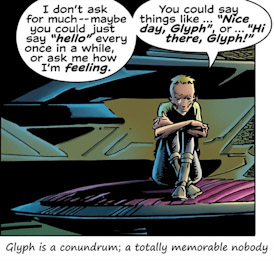 It seems the reader had been heard.
It is in Book Two that the character I remembered, or thought I remembered, appears. Simply known as the Glyph, we get ‘their’ story in episode 3: ‘I’ll never forget whatsizname’. Born boy or girl, they can’t remember, they go through 47 gender operations or ‘remoulds’ , which destroy their mind and body. They become such a boring nobody that they practically become a superhero with the ability to go to a supermarket to freely take food or live in a hotel room without the staff noticing. It is in this instalment that the power of the comic over written literature, or theatre, shines through. Like film the viewer is forced where to look and what to see. Now a stowaway and living practically unnoticed with Halo, Glyph tells their story. Being such a nonentity Halo and friend Toy drift away to watch and chat about soaps. A description of the action is not needed in comic or film. A simple one frame, or edit, repositions the two in the room room as Glyph continues talking. Glyph saves Halo’s life twice, but of course the girl is oblivious. A fantastic creation with an important, and ultimately sad role to play that only we witness. Glyph is a conundrum; a totally memorable nobody. Set on the Clara Pandy, Book 2 has a lot more action and gore with a hostage situation and when Halo finds out who killed Brinna. There’s also intrigue and tension with Halo’s life threatened if she cannot replace a dying rat, an action that has consequences in the following book. However, the book ends on a down note and a reference to the film Casablanca, which must have been lost for a majority of readers. Again, a very strange way to keep readers engaged but Halo has at least become a character one can warm to.
Book Three (1986) again starts with a prologue but this time it has a better function than just recapping. Halo is now 29 so it explains the last ten years of her mundane life, going from planet to planet looking for work and slowly turning to heavy drinking and being thrown out of bars. There is also later a vague reference to self harm and Halo hacks her hair off with a knife. A comic for late teenage boys? Ho hum! She meets up with Toy, the friend from the Clara Pandy, and they do what anybody on the skids does - join the army. Here Moore handles the usual tropes of bonding, training, bullying, camaraderie, rivalry, humour, death and even suicide with skill and passion. Halo: I thought you were dead. Toy: Don’t be stupid, I’ve never been dead in my life. Book Three is a look at war 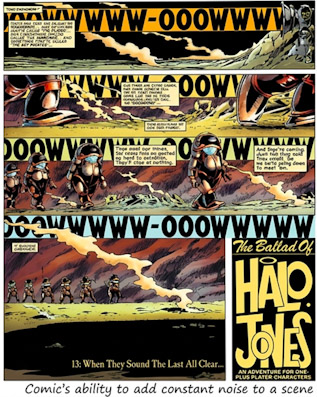 with all its horrors and is brilliant. One particular battlefield is set on a world with such high gravity that time slows down. To survive the soldiers must wear huge suits that look ridiculous giving a comedic edge – until they explode. The war ends and Halo discovers the truth about her forced actions on the Clara Pandy and seeks revenge. This final book could easily stand alone without the other Books’ back story. Here we see another odd advantage of the comic over straight literature which is the ability to add a constant ‘soundtrack’; to have a siren or beat of drums behind every frame so the reader is very aware of the never-ending noise. A device used with great effect on several occasions.
At Book’s end she has lost all her friends, lost her past, and, by being a lover and a murderer, has lost her innocence. The only thing she can do now is be herself and ‘go out’. The story and artwork exceed the other two books and is a fitting, but unintended, ending to a wonderful creation. It was sad to let go of Halo, but I am relieved there was no Book Four with Halo entering her 40s, as for me this particular ending works.
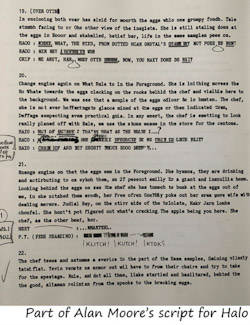
I totally loved and was moved by this book, even if the black and white original had been coloured. It was funny, annoying and often incredibly sad. One thing for sure: Alan Moore was, and still is, an extremely gifted writer and stage manager, just looking at his script shows this side of comic book creation. Many have rightly praised it, with British Comics Fandom saying ‘The Ballad of Halo Jones is easily one of the best strips that 2000 AD has ever produced, and one of the highlights of Alan Moore's career.’ Which certainly places it in Watchmen territory. However, on the back cover a quote by currently cancelled Neil Gaiman states: ‘One of the first great comics… up there with Watchmen, V for Vendetta, Dark Knight…The things we talk about when we talk about comics, Halo Jones should have been one of them’. Should have been? He’s right, even in Moore’s bio in Watchmen, Halo Jones is not mentioned. Why isn’t it? Could Book One’s unorthodox slow start be holding back a graphic novel, albeit flawed and incomplete, from being called a classic? I hope not because that slow beginning shows two artists working and sticking to a brief that breaks the mould making this graphic novel stick out as unique; as a true classic.
----------------
END NOTES:
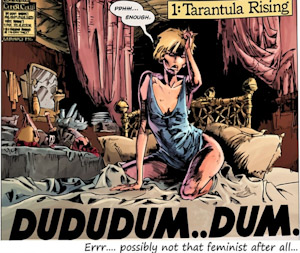 1: The Guardian’s ‘feminist heroine’ tag should be taken with a pinch of salt. Halo is a strong female character, but she just gets on with, or is beaten by, life and doesn’t preach or belittle…much. By Book Three Gibson ‘showed some respect’, sorry, I mean his true colours, by showing nipples under a T-shirt and having Halo provocatively pose in bed. She likes soaps and they are often the only things she talks about, which is stereotyping at its worse. I think these points would anger most feminists. As a Van Winkle I have no idea of any other female comic personalities who are not superheroes apart from Jessica Jones who does have some powers, an interesting last name, a drink problem and ages. Halo Jones is unique and obviously very much an influence, though Jessica’s creator denies it.
2: To attempt to rectify my ignorance of the Graphic Novel I ordered Moore’s Watchmen and V for Vendetta. Both of which were originally serialised. I know them from the films which Moore hated. It also seems DC have swindled Moore out of millions thanks to a dubious clause in the contract. The books arrived the other day and as I cast my eyes over them, I realised they too have been colourised. Ho Hum.
Also see comic related interview with Mick Mercer and a comic related QUIZ
© Garry Smout 2026
This article may not be archived, reproduced or distributed further without the author's express permission.
Please see our conditions of use.
Author Bio
 Michael Garry Smout, seen here wearing his beloved D.R and Quince T-shirt, in Barcelona, early 90s, is one of the founders of TBR. Apart from the layout and artwork he has contributed several essays that range from the role of authors in designing their Book Covers to the importance of prediction in a story. He has been working on his debut novel for so long that many of his characters have retired.
The Barcelona Review is a registered non-profit organization