


 DANNY LANZETTA
MY WIFE’S SECOND HUSBAND
My wife’s second husband is handsome, I’m afraid to say. Much more so than I was, and with the heavy, stolid presence of musky man I could never claim. I imagine a perfect proportion of gray and gray-white and black-gray-white hairs sprouting on only the upper region of his chest, where my wife may lay her head before bed and feel safe. Back when we were married, my wife and I used to spend Sunday afternoons in the same manner she’s now spending them with her second husband. I’d be sitting across from her, just like he is now (albeit much more handsomely) on one of our summer getaways out east as we shared an appetizer on the patio of a country café, some place we found after driving aimlessly, one of my favorite pastimes, through hushed hamlets of upstate New York, or ecclesiastical pockets of New England that always looked as if they were missing snow, or the shitty coastal communities of New Jersey which, in summer, were full of families celebrating their seasonal proximity to an ocean whose homicidal apathy must be ignored for the vacations to serve their purpose. It seems she has now taken up this little “peculiarity” (her word, not mine) of driving without destination, adapted it to the purposes of her new situation (her second husband), perhaps in acknowledgement of an advantage gleaned from a previous life, something she could appropriate and make her own; or perhaps (and this might speak more kindly of our time together) subconsciously as something she absorbed over many years and many drives, became fond of for both the afternoons as well as the symbolism, and which she came to see as not merely my peculiarity but ours, a salient distinction which seems the epoxy bond of most effective relationships (especially in light of diminishing sexual returns) and the weakening of which is often the final straw in the inevitable atrophy of a marriage. It seems to me (and perhaps this is because I am dead, but more likely in spite of it) that a marriage is a race to death, not in a negative way (though it’s hard to acknowledge such a notion in a positive light, I know), but if you can get to the end before those bonds are severed, before the peculiarities become nuisances or worse, then you have won! From that perspective, my wife’s second husband gives her a distinct advantage, if for no other reason than the practical consideration of less time for the invasion of corrosive influences, the most likely being betrayal and children. My wife and I never betrayed each other so far as I know, and we never had children. Suffice it to say, there were other problematic factors. Now my wife is giving it another go with her second husband, “pushing her luck” so to speak, and trying again. Not that I begrudge her the opportunity. Far from it. Lord knows she deserves it after putting up with me all those years, the drinking – which never became behavioral, but still – the lethargy, and the feeling, which I never uttered but could never quite shake, that my wife (an intuitive woman, if not particularly well-read) surely picked up on, the sense I always carried, like a piece of undigested meat in my stomach, that I was meant to be something more impressive than my wife’s first husband. To this day, I have yet to figure out why I felt that way, or what I imagined I was supposed to become, what would’ve mattered enough to make the feeling go away. I’ve often wondered if I could’ve been a better husband by being more content, or if I would’ve eventually craved a different kind of wife, one who fulfilled the idea in my head of what a successful man ought to have, or no-wife, you know, the kind of man who goes gallivanting around, not necessarily for sex, but more because of the flexibility that no-wife provides, the opportunity to flit and flail and wake up the next day without the expectations of spouses and parents. Parents never quite go away, of course, but the nice thing about wives and husbands is there can be others. Case in point, my wife’s second husband. And here he is taking up a Sunday afternoon with my wife, which used to be my responsibility. Thank you, my wife’s second husband! Thank you! I don’t know his whole story, but it seems like he’s also getting a second chance. And I’m glad for him too. Except, when you think about it, it’s hard not to wonder. You know, wonder what it was all about in the first place. All the getting to know you and the getting to love you and becoming disappointed by you amidst various kinds of learning, years and years of buildup, intimacies shared, damages inflicted, thousands upon thousands of silences, the character of which, depending on who you talk to, is either long love’s defining testament or a malignancy of accumulation. What’s it all about if you can do the same thing with anyone else? Well, maybe not anyone else, but someone else, that’s for sure. Maybe you can’t afford to admit it when you’re alive, but it’s really a no-brainer. There are hundreds, maybe thousands of someones who could replicate these Sunday afternoons with my wife, or, if the situation were reversed, with me. Who knows? There might be twenty or thirty in your immediate vicinity right now, within a stone’s throw, so to speak, and that’s for a small town, like maybe out in Montana or Wyoming, much less New York or Chicago where sometimes, if the wind is blowing just right, it feels like you can fall in love with half the city in a single afternoon. Which seems great and all when you’re alive because it means there are lots of options, the whole “plenty of fish in the sea” thing. But if there are so many possibilities, why do it in the first place? I get it. I understand the impulse. I mean, there are an awful lot of Sundays to fill up over the course of a lifetime – to say nothing of all the other days of the week – even a relatively short one like mine. Aloneness is one of the few illnesses that seems attractive in the abstract. There are all sorts of things you think you can accomplish when you’re alone that are impossible, or seem impossible, when you constantly have to account for your time. Whole hours, days, and weeks that would be suspiciously unannotated to a spouse, simply end, leaving little to no impression on anyone or anything, a glorious state of untraceable evaporation that even the most mundane instances of marriage, if only by virtue of institutional definition, cannot replicate. Except…nobody wants to evaporate. It’s too terrifying to have weeks upon weeks or days or hours when nobody anywhere has any idea where you are, what you’re doing, what you might be up to. Which is why I don’t blame my wife. It was fast, sure, the way she went from me to her second husband, but how much was she supposed to endure? What would’ve been the correct amount of time for her to grieve so that when she finally did move on, the neighbors wouldn’t look at her askance? I submit they’d view her crookedly no matter how long she waited (unless it was a decade or something ridiculous like that, in which case you can bet there’d be some people who had a hard time remembering what I even looked like), particularly the ones who were originally my friends, and especially the ones who became partial to me over the course of our friendships. (Bill and Carol from down the street come to mind. They never said anything, but I could still see it in the way they looked at each other on our living room couch whenever my wife did something obnoxious in their presence.) By all accounts, she had fallen out of love with me (not that I ever bought that, not even for a second). Still, it’s hard not to wonder how she could cut herself off so thoroughly, as if she could’ve just as easily enjoyed eating those Sunday appetizers in the country across the table from anyone, that she was really and truly just passing the time. It certainly seemed that way in the aftermath. (And to be fair, that kind of behavior doesn’t bode particularly well for my wife’s second husband.) My wife severed all ties. She de-friended my sister on Facebook. She took a phone call from my mother three weeks after the funeral and said, “Yes, Mom, I love you very much and am very appreciative for what you’ve done, but I can’t be in touch anymore for what I hope are obvious reasons,” to which my mother couldn’t respond because there was nothing obvious about it. There were other signals too. For example, when I first got sick, and the prognosis wasn’t yet disgusting, and she should’ve still been in the mourning-phase, the shocked-phase, the denial-phase even, my wife made a number of curious financial decisions including but not limited to selling our house, which we had talked about but had not fully decided. I went along with it. Everybody knew we were splitsville, sick or no sick, but she didn’t have to be so rude. I overheard her talking about these things to my family in the hallway of the hospital, which seemed more than a little insensitive, especially since my parents had always treated her “like one of their own,” a saying that carries a threat to undermine the sentiment, relegating the object of such (allegedly) unqualified affection to a simile. Still, they cared for her and she didn’t need to be so blunt, even if it was becoming clear that she didn’t care all that much, or, if not exactly not care, then at the very least was ready to move on, ready, as it turned out, to have a second husband. I mean, my sister used to refer to my wife as her best friend (a lie) for crying out loud! And look at her now! Here she is, boys! With her second husband on a Sunday in the country, doing almost exactly what we used to do, sharing pâté and crab croquettes. (We always loved that particular combination of flavors.) Is there no shame in this woman? Are men simply stand-ins to her? Muscle, meat, and marrow in some genetically recognizable arrangement and to hell with the details? Who cares what books he’s read, who he votes for, what sort of dental hygiene he practices, as long as he’s biologically proper? I’m pretty sure that’s the table we used to sit at. I think we were in that exact same place on the day I told her what I foresaw, what was so clearly coming given the sudden onset of certain symptoms, which I’d told her about but she hadn’t taken seriously. “I’m thinking about you in the future, how one day you’ll be sitting here with your second husband,” I said. That day she cried at the thought of it, tried to be reassuring. “We’re going to grow old together, honey. You’ll see. You’re just a hypochondriac.” I was a hypochondriac, that much was true. But I tried to warn her that even with all the false alarms, it stood to reason, just by the law of averages, that one day I’d be right. And I think when it finally happened, it was a relief to her, not because she wanted me to get sick, but because divorce or no divorce, she didn’t know how else to ever truly get rid of me. I feel bad she had to endure that sort of guilt, to know she didn’t want me anymore, had probably been thinking about it for many years, was working on the nerve she needed to extricate herself, so that my illness, while certainly nothing she’d hoped for, became…well…convenient. She would never have to tell me she didn’t love me anymore, or perhaps, now that she was older and understood what love really involved, had never loved me to begin with, at least not in any way that should’ve been more than a passing fancy, something to take up a small stitch of time instead of year upon year, a man good enough for a few Sundays, but not good enough to occupy as many as I did. My poor wife! There she was in the wake of my prognosis, trying to reconcile a horrifying satisfaction, a grim pleasure she was powerless to unfeel, so much so she couldn’t resist the temptation to rub it in my family’s face, incapable of delaying her delight even as she knew how monstrous she must have appeared. Can you imagine such agony? I don’t envy that, the knowledge she must have had that she was embroiled in the last moments of a significant portion of her life, fifteen or so years that had unfurled interminably, the macabre crawl of the quotidian, but also the kind of time she might look back upon one day and say, “Look how fast it went!” (It is the paradox of time we allow to destroy us, like children we insist it work both ways, never acknowledging that neither is true.) And all this is to say that my diagnosis coincided with my wife’s final days as my wife, which is probably a bigger change than death when you think about it. And because it is now apparent to me that she didn’t want to be my wife anymore – in all likelihood had spent many years trying to figure out a way to shed that identity – well, yes, then maybe she didn’t handle our dissolution with the requisite aplomb. Good. Good for her. There’s too much fucking aplomb to begin with. So what if she offended a few people on her way out the door? My mother got over it. My sister got over it. (My father might still hold a grudge.) After all, they had lives to attend to as well, lives that would certainly be altered, but not as drastically as my wife’s, that’s for sure. And so she cut ties, moved to another town that wasn’t far from and looked suspiciously like the one we lived in, but fine, married her second husband within a year. She didn’t invite my family to the wedding, which, can you blame her? And now, enough time has passed. It is long enough that my parents and sister probably don’t think about her all that much anymore. Long enough that my wife might not recognize a correlation between her current Sundays and the ones with me – though it would take some pretty extraordinary mental gymnastics to pull that off – and also long enough that it is quite possible that my wife’s second husband and I have exchanged roles. Before, I was the first husband of whom she’d grown tired, the abstraction of her second husband something she dreamed about. She would no longer feel so weighed down, would be motivated to become the woman she always felt she should’ve been. (It’s quite likely, though I never asked, that my wife always felt she was meant to be something more impressive than her husband’s first wife.) Now, it’s quite possible that nostalgia has cast our relationship in a more flattering light, and it is my wife’s second husband who is disappointing her on a Sunday afternoon. And while that would certainly seem a victory for me, I can’t, in good conscience, be pleased. You see, the thing of it is, I loved my wife. And while I believe it is overstated how much we are genuinely interested in each other’s happiness, in this case (for obvious reasons) I no longer have any aspirations. So. While it would be nice to think that my wife is having a kind thought about me on this Sunday on the patio of a country café, it isn’t strictly necessary. We almost always move on, even if we visit the same towns and restaurants, and all this grappling about will eventually end for all of us, it’s true, but wouldn’t it be nice – particularly for my wife’s second husband – if she could figure it out before he ends up like me?
© Danny Lanzetta 2026
This story may not be archived, reproduced or distributed further without the author's express permission.
Please see our conditions of use.
Author Bio
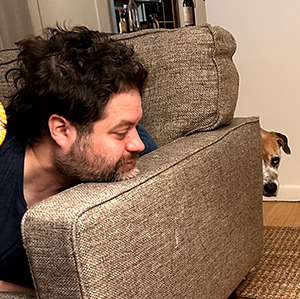
Danny Lanzetta is a writer and teacher. His most recent novel, Scenes from the Flesh, was published by Atmosphere Press. He self-published his first two novels, Drunken Angel and Gadfly. He is also a spoken word artist whose music is available on Spotify. In a previous life, he appeared on Broadway in Les Miserables and Neil Simon's Lost in Yonkers, was the original Jason in Falsettoland, and the lead on the CBS primetime series Brooklyn Bridge. After more than 40 years as an inveterate New Yorker, Danny currently lives in the atmospheric river that is Seattle with his wife and dog. In his spare time, he is a deranged fan of the New York Knicks. Visit www.dannylanzetta33.com for more information.
The Barcelona Review is a registered non-profit organization