


 Salva Deluxe Barcelona
by Ryan Chandler
Barcelona INK Books, 2026
Set in the years just prior to the 1992 Olympics, the author revels in the wild and woolly era that was Barcelona at that time. No massive tourist invasion as yet. Dead-cheap menús-al-dia. A liberated atmosphere with pot allowed in many a bar. Cheap alcohol (the one thing that hasn’t changed). As he characterizes it:
The pre-Olympic Barcelona to which he is running is having a torrid fling with itself: dirty, decadent and dancing in the streets. ‘Afters’ bars that open when the clubs close, a burgeoning gay scene, and a blind eye being turned to the vast number of drugs fuelling the party. Overseeing it all, an inflatable yellow sheep-dog called Cobi and his companion, Petra, the armless transsexual . . . . Anarchic, crazy characters everywhere, uber-designed bars, general madness.
Our narrator seems to mirror this anarchic atmosphere, with all manner of authorial intrusions and chapter endings that directly ask the reader a question or invite consideration of a topic. But once you accept the metafictional flow of things, you’re off and running.
Not surprising that our out-of-work English protagonist is drawn to the city. He fancies himself a rebel, but is a naïve kid bumbling around a foreign city, stupidly blasting music so loud he gets kicked out of his rented room. But that’s what you do when you’re young and carefree, right? And he does love music, even has DJ aspirations. After all, he brought along his record collection and a Marantz amplifier, along with a Pioneer turntable and a lone Wharfedale speaker. The kid knows his music and musical references abound, which is all part of the fun. Top of his set list is Planet Claire: “Tremolo guitars and reverb. Hypnotic riff. Bassline straight out of Henry Mancini’s Peter Gunn. Analogue retro future.” Then come Radio Clash, Groove Is in the Heart, and Sex & Drugs & Rock & Roll.
Early on, he decided he needed a nickname, so Salva it is, because “Salvador is a name with cultural and revolutionary credentials [and] the diminutive, Salva, is also Spanish for a round of bullets. Blanks. A round fired in the air.”
Our lucky rogue meets a girl, who knows a guy, and before you know it, he has a one-off gig at an uptown club, Univeral. But how to make his gig really stand out so as to keep the job? I don’t want to spoil the fun, but I could especially appreciate the “hook” he chose because I was living here then and I remember the source. I also loved the lunacy of youth that could even envision such a plan.
For a wild romp through the city at what many would call its heyday, and for the sheer joy of experiencing youth unleashed, with some lessons learned along the way, and a bit of Barcelona history thrown in, dive in.
JA

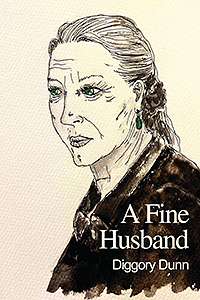 A Fine Husband
by Diggory Dunn
Blue Cubicle Press, 2026
A Fine Husband is presented as five Acts, with interludes of a short dream play and a lengthy letter exchange between one of the characters and a judge of the 5th district court, Colorado, in which various legal complaints are expressed (see excerpt here). Most typically, however, it is a collection of interconnected stories, though hardly in linear fashion, in which maximalist prose is pushed to comic extremes. It is very British (“Get to buggery!”;“Hell’s teeth!”), at times using somewhat dated language (“feckless tarts”) and deliberately odd syntax (“The door was arrived at, and, with bone and white knuckles, was crisply knocked”) to heighten the comedy. Once you get into the rhythm of it, you’re in for a rollicking good ride.
Dame Raya Velo, British icon and two-time Oscar winner, is the chief protagonist. The book opens with Raya in the dressing room of the decrepit Old Mysore Theatre, which she purchased for the purpose of presenting a play about her French late husband, a play which she wrote, produced, is directing and will star in. She is 72 years old and has sunk all of her money into the project. The chapter ends with her trashing the dressing room as an unwelcome realization—about the play, herself, or both—begins to sink in. Later, in a chapter near the end, we get a full account of the cleaner’s reaction to finding the mess in the morning.
Raya’s back story begins with her days at a Catholic boarding school where the nuns made a shrine “composed of hundreds of former students’ milk incisors and canines, first fashioned by long dead nuns into the shape of a dove” (!!!); and her younger days in Notting Hill during the swinging 60s, which barely enter in except at a party of her downstairs’ neighbors where she meets her future husband. As our narrator puts it, London in ’69 was “alleged to have been a magical time . . . was the moment of love, of drugs, of free expression and creativity, pent up, repressed for so long by the centuries of austere parents . . . [but] that morning, the shopfronts, attire, the general palette and atmosphere, the rain, seemed to indicate such shifts might be superficial.”
Playing the French late husband is long-time friend, Sir Thomas Bellinger, another British icon who also has gained fame through American cinema. Back stories of Sir Thomas are interspersed along the way—as a younger man in the US, dropping in on a party of friends in Kentucky; an even younger Thomas attempting to ride his bicycle with a girl on the back to school for O-Level exams; and as an older man in York, where he has been asked to come dig up his time capsule in a ceremonial event. There is also a coming-out scene which does not go down well with his brother.
Raya’s first husband, American film director Lionel Henning, with whom she had two children and is now divorced, enters in periodically, along with his second wife and stepdaughter, Lily, who appears to have died either of an overdose or a pickle or both, bringing on a giggle in any case. Then at one point, we get Lionel’s back story which includes how he met his wife-to-be, Helen, at the Muncy Muncipal Library: “The beauty of Troy was born of Zeus and Leda the swan, my Helen was born unto to me in that collision of Mrs. Baronet’s [head librarian] begrimed clavicle with a protuberant towel rail amidst a kinetic symphony of billowing flesh and colonial bathroom furnishings.” In other words, Mrs. Baronet fell down in the bathroom and her assistant, Helen, took over as head librarian. This is Lionel’s Baroque, over-elaborate diction, as seen elsewhere in his exchange with the judge. The circumlocution itself becomes the joke and that is the essence of much of Dunn’s writing.
Thus, we have phrases elsewhere such as “bipartite colloquy” for a chat between siblings; “bituminous Glaswegiantorrents” to describe a man’s throaty voice; “wayward fang” for a crooked tooth; and “notes of excrement tugged at Thomas’s nostril hairs”.
A whole array of other characters enters, some of them seeming to have little connection to the whole, as with Barrett, a man Raya spends time with in a Wyoming resort while on a shoot, a chapter that serves mainly to shine light on the French husband, though an oblique reference to him pops up near the end.
Despite the meanderings, which can be entertaining in themselves, everything builds to the big opening night of Monsieur Bonhomie. Will it be a success or an utter flop? By this time, the reader has a vested interest in the outcome.
There is also a reference to Oscar Wilde’s An Ideal Husband, which inevitably invites comparison. Just as Wilde’s “ideal husband” was not so ideal after all, we have learned that Raya’s late husband was not so ideal either.
The best way to approach A Fine Husband is simply to roll with it. It is an ornate mosaic whose individual pieces are fascinating in themselves, but whose full impact emerges only when you step back and see how they fit together. So enjoy the fun along the way, as well as the reflections on love, loss, the creative process, culture and the passing of time, and have a good laugh at the buffoonish Lionel, the worldly, ever-dramatic Raya, the endearing Thomas, and the whole motley crew, and trust that the pieces will fall together.
JA
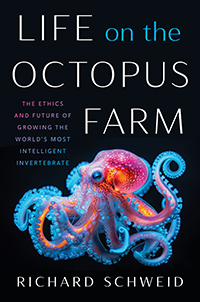 Life on the Octopus Farm, the Ethics and Future of Growing the World’s Most Intelligent Invertebrate
by Richard Schweid
University of North Carolina Press, 2026
You may think you haven’t much interest in octopus farming, but with Richard Schweid’s exquisite account, you can set your doubts aside. For one thing, it’s about so much more than the farming itself. As a cover blurb reads: “Readers will emerge from this book smarter, more worldly, and more humane.”
Schweid focuses on three primary locations where octopus farming has been attempted: Sisal, Mexico, Galicia, Spain, and Japan. The Sisal story is especially moving as the farming, begun in 2005, was brought about by a marine biologist, Carlos Rosas, who hoped that the research station would help contribute not only to scientific knowledge, but also the well-being of the village where it was located, home to a small Mayan population. We learn about the difficulties in trying to farm octopuses (the preferred spelling, the author tells us) as well as the way of life of the Mayan community. Lunch was eaten on site, cooked by Doña Silvia, who “grilled coots over a bucket of charcoal and served them with lime, cilantro, chopped onion, rice, black beans and plenty of tortillas.” Best yet was the lively table conversation as “no one wore earphones . . . and there was not even a radio in the storeroom." We get to know these people and to care about them. As it was all beginning to come together, a devastating fire burned down the octopus tanks in 2010, an act suspected of arson by developers who did not want the farm to expand. Rebuilding began but it was, and continues to be, arduous work.
Galicia, Spain, has always been octopus country. Researchers envisioned octopus farming to be easy, but of course it was not. As Sisal had learned, it took years to learn how to keep the paralarvae alive, and even then survival rates were low. There was also cannibalism as it was hard to find the proper formula to allow the paralarvae to grow. In addition, octopuses can escape from virtually any enclosure. And they are short-lived. And they like their food to be alive. The author traces how various big commercial ventures tried to capitalize on the farming, but how it never really took off. He also tells of how the locals prepare and serve octopus (“polbo” in Galician), which was so mouth-watering it sent me off to my local pulpería in Barcelona for some pulpo a la gallega, “pulpo” being the Spanish name.
Japan has not fared well either in farming octopus. We follow its attempted trajectory while suffering with the author as he writes of arriving in Tokyo, alone, overwhelmed and disoriented, as he searches with difficulty to find a nearby capsule hotel, which proved a harrowing experience on its own. We are introduced to the tasty dish, takoyaki, basically wheat-flour batter balls with octopus (“tako”) at their center, a popular street item, as well as a variety of other dishes, while receiving glimpses of the country and learning its customs, one of which required the author to offer a little gift to his hosts. Being a Barcelona-based American, he chose a mosaic lizard refrigerator magnet in the trencadis mosaic style of Barcelona’s most famous architect, Antoni Guadí, well known to many Japanese.
So who is the biggest exporter of octopus in the world? China, which sources octopus from fisheries in North Africa and elsewhere, as far afield as Chile, with Morocco also a major player. Most importantly, virtually all commercially traded octopus is still wild-caught rather than farmed. Which brings the question: should they be farmed? The author presents both sides of the argument. On the one hand, “octopuses are sentient beings, capable of experiencing pain, distress, and happiness, and that high-welfare farming of them would be impossible.” On the other hand, in small-scale ventures, where the welfare of the octopus is made possible to some extent, it provides a livelihood for the locals. Additionally, in looking to the future, octopuses can provide necessary micronutrients in places lacking good nutrition. As to how to get countries like the US to adopt octopus into their everyday diet, that would take the work of lots of social media influencers, the author concedes, before we see fast-food takoyaki chains, assuming it could be made affordable.
The biggest danger in reading this book is that you will feel compelled to bombard your friends with octopus trivia: Do you know how many hearts an octopus has? How many brains? How long they live? How they mate? What happens to a female after her eggs hatch? What happens when you look an octopus in the eye?
But quite apart from all that is the care, intelligence and curiosity with which the author approaches his subject, and the broad brush used in presenting it to us. He takes on what might seem like a narrow subject—octopus farming—and opens it into a much larger story about science, food, culture, livelihoods, animal intelligence and the difficult ethical choices we face when human needs collide with the lives of other sentient beings.
JA
© rbr 2026
These reviews may not be archived, reproduced or distributed further without the author's express permission.
Please see our conditions of use.
The Barcelona Review is a registered non-profit organization